
Sweden, pt. 3
birth of a welfare state

The Sweden series continues. Part one is here; Part two is here; and I have cobbled together an accompanying Spotify playlist.
Build Something Lasting
When Mary Wollstonecraft traveled around Western Sweden in the late 1700s, she encountered only muddy backwardness—a people living in a kind of medieval slime. The Stockholm novels of Per Anders Fogelström open at the turn of the century, with soot-faced kids selling their asses to old men for pieces of candy.
How did they go from that to this sleek, beige hypermodernity in a century?
Most European social democracies developed along a certain track. After a close call or some kind of domestic uprising in 1917-1920, Social Democrats would swoop in and use the specter of Bolshevik revolution to extract concessions and reforms. Give us this now or you’ll get nothing later.
Even among this cohort, Sweden remains a peculiar case. No real run-ins with actual Bolshevism, no Bavarian Socialist Republic, no mutinous army and strike waves like in France, no Bela Kun. Sure, there was a rising Swedish Communist Party, but overall peaceful and drama-free. It never really went anywhere.
Country was too genteel. Too drawing-room, tweedy socialist. The people who got control of Sweden were the people Lenin loathed, who he split with and hammered away against in theoretical journals.
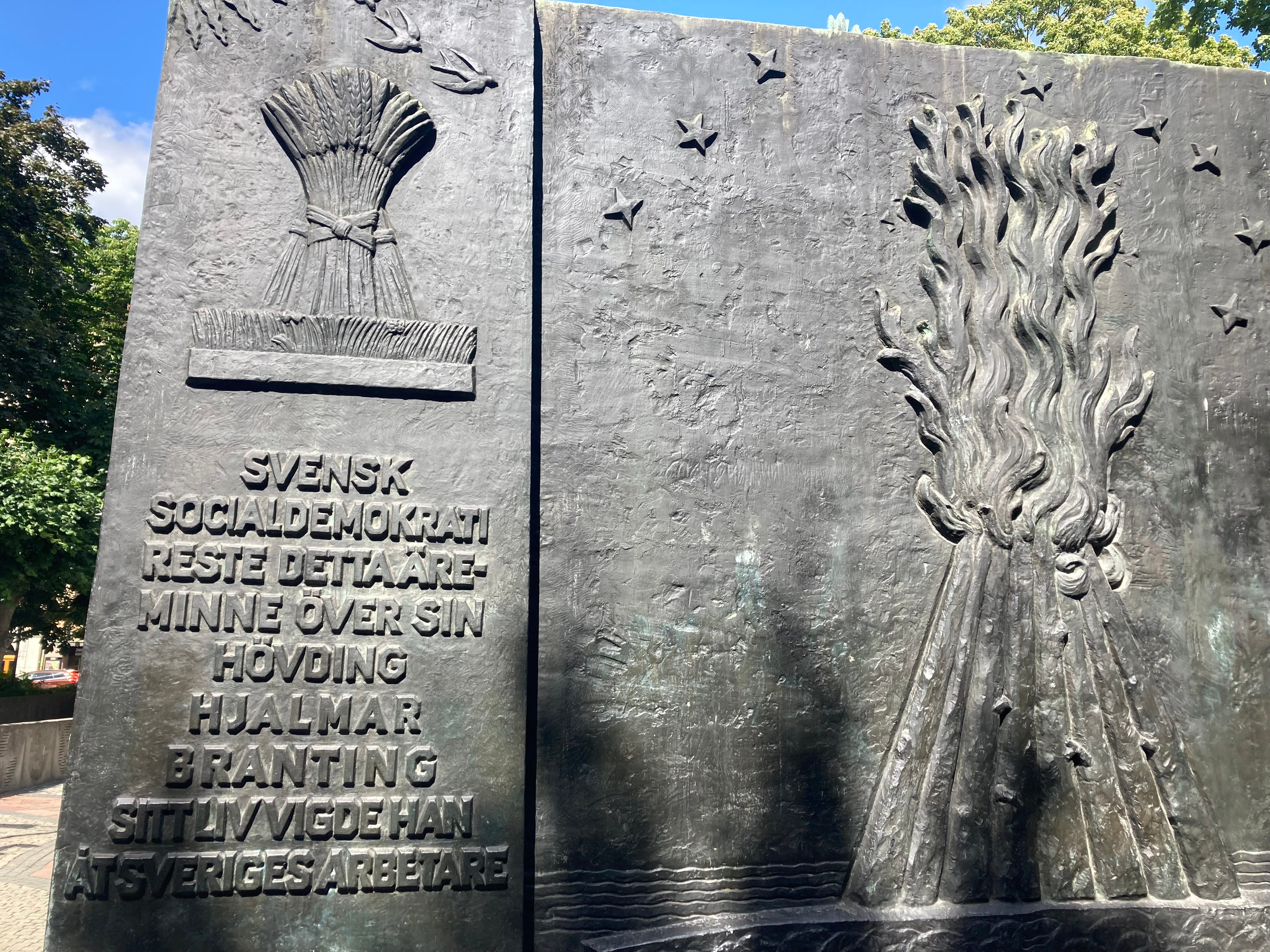
During World War I, these revisionist Social Democrats, led by a literary critic named Hjalmar Branting, waged a peaceful electoral revolution. They built an unlikely coalition of farmers and white-collar urban workers—and established a parliamentary democracy with universal suffrage and the basics of a social safety net.
They squeezed out the anarchists and the Swedish Communist Party, and established a hegemonic voting bloc that endures to this day—sure, in a diminished form, being eaten away by gains on the populist Right and Left, like everywhere—but still a very deep Deep State indeed.
Branting & Co. were forged in the great debates of the late 1800s Second International, alongside Engels and Eduard Bernstein—the split between “orthodox communists” and “revisionists” led to separate parties.
In the 1920s and 30s, the ruling Swedish Social Democrats rapidly modernized the country and attempted to chart an independent, non-aligned course between fascism and the Soviet Union. The Communists were deeply disappointed by this “social fascism” as it was called at the time. The Social Dems did steal some of their most popular ideas from the fascists—like corporatist industrial labor-relations and the notion of Folkhemmet (The People’s Home)—but they did so largely without becoming (at least in public policy) Jew-baiting race-obsessives.
A Folkets Hus (People’s House) still stands in every Swedish town, always at the center of town, usually near the Social Democratic Party headquarters. Community gathering places. Vestiges of a previous time when the Swedish Social Democrats attempted populism to promote culture and togetherness—nowadays somewhat empty, slightly awkward in the prime business real estate they occupy, holdovers from when they were actually highly valued by the Swedish Folk.
The modus operandi of the Social Democrats was always flexibility and adaptability. Even the left-wing Swedish Social Democrats and Swedish Left Party’s (the reincarnated version of the Swedish Communist Party) plan has always been to gently bleed the big firms and ownership class, taking a drop at a time from their bucket and placing it into the labor-worker bucket.
This ambitious democratic-socialism reached its apogee in the 1970s, under Olof Palme and with the Meidner Plan, which attempted to socialize and redistribute corporate profits through shares—which would have essentially been a Trojan Horse to piece-by-piece socialize big companies. Needless to say, it was crushed and the Social Democrats were voted out of office, and ten years later Olof Palme was assassinated.
Bernie, FDR, and the Nordics in the American Imagination
America’s first fling with the Nordic model was not 2016 Bernie Sanders campaign and the Dirtbag Socialism craze—it was the Roosevelt administration.
In the 1940s, the journalist Marquis Childs wrote a series of articles for Harper’s and pop non-fiction books celebrating social democratic Sweden. The biggest of these was Sweden: The Middle Way followed by How The Scandinavians Do It.
Unlike other journalists and fellow-travellers who wrote breathless paeans to the Soviet Union or awe-struck hagiographies of the fascist leaders, Childs subject choice never came back to bite him in the ass. (A typical London Times journalist in Italy, in 1923: “Fascismo has abolished the game of parliamentary chess; it has simplified the taxation system and reduced the deficit to measurable proportions; it has vastly improved public services, particularly the railways; it has reduced a superfluously large bureaucracy without any very bad results in the way of hardships or unemployment.”)
Childs’s books and articles were picked up, studied, and sometimes blurbed by the Roosevelt Administration.
A representative paragraph from 1947: “The wisdom of the Swedes lies above all in their willingness to compromise, to meet what appears to be reality. They have not been ‘bound’ by a system, nor have they been committed to dogma. In a sense they are the ultimate pragmatists interested only in the social order. This may explain why their contribution to political and social thought has been so slight.”
Sweden’s social democracy didn’t embarrass because it wasn’t extreme—it didn’t rely on coup d’etat, expropriating and deporting kulaks, or violently suppressing political opposition. But it also didn’t quite excite.
As Ernst Wigforss, one of the theoreticians who founded the modern Swedish state put it directly: “The goal of social democracy is to transform bourgeois society, not by eliminating the bourgeois in a violent struggle, but by democratizing the power and property held by capitalists.”
You can almost hear centuries of radicals sighing with irritation: Gently transform bourgeois society over time by slowly changing incentive structures? Boring!
Sweden’s revolution might not be the sexiest revolution, but it has been the most lasting—the founding structures and the total political hegemony of the Social Democratic Party have been in force, with a few brief interruptions and interregnums, for almost a hundred years.
After the collapse of the Soviet Union and Tiananmen Square, the Western left had to regroup and self-bargain over some of its grander ambitions. And find new places to project its hopes and dreams onto.
Many settled for social democracy or democratic socialism. Bernie and Michael Harrington brought democratic socialism and the Nordics back from the dead.
Starting in 2016, the Nordic countries took the place in the American liberal imagination as big rock candy mountain, where life could just be better.
Bernie injected the “Look at Denmark—why can’t we have healthcare? Why can’t we have nice things?” thing into the culture. In those years, you couldn’t turn on a podcast without hearing Matt Yglesias analyze Swedish data or Matt Bruenig break down the Finnish welfare system.
But those years were also the escalator towards Peak Woke. Bernie and his people caught a lot of flak for pointing to the Nordics as an example for us to follow. A Scandi social democracy had only been possible, they said, because they were all white. Just like Bernie’s little social-democratic fiefdom in Vermont. A functional, high-trust society only emerged because white people trusted each other enough to share things peacefully. Wasn’t possible in multi-ethnic or multi-racial societies, they said. We had to put that aside and Elevate Other Voices, entrepreneurial voices, set up DEI HR programs.
They sniped in the media and physically interrupted Bernie’s rallies. They sabotaged him from the inside. And ironically, their view was exactly in line with the racist identitarian view—that the Nordic welfare states were great before the societies diversified, let in all the rabble, who ruined a perfect society.
Everything Just Works
The state is built around transactional politics of white-collar middle-class young people—hence the extreme and growing family policies. People have children almost casually, with people they’ve only known for some months or a few years.
They do not often get married. If they are both native Swedes, they know that the worst case scenario is they split and then, again, more than likely, the two parents will live in either Stockholm, Malmö, or Gothenburg, all of which are a quick train ride from each other.
They know that if they become parents the welfare state unlocks for both of the parents—generous social support begins to flow, 12-18 months of 80-90% of the wage of the higher-paid parent. And a monthly stipend for child supplies until the kid turns 16.
Many kids will go to some kind of pre-school at age 1 or 2 and the cost will be $100 a month. So just as the “parental leave” is ending for both the parents, the day-to-day care of the child will be taken care of by the state.
The healthcare system is administered by the regions. The wealthier the region, the better the healthcare, just like in the US. To visit a doctor costs about $25. I do not find there to be long waits for specialists or general doctors, but I have heard sometimes there are long waits. An emergency room visit is between $25 and $50. An ambulance ride included, if necessary.
Many people balk that the healthcare system is underfunded and Potemkin, mostly meant for triage and turning people away.
There is a joke, like all jokes rooted in truth: You go to the hospital with a broken leg. The doctor says, “take two Tylenol and come back in a few weeks if it’s not better.”
At the same time, care can be excellent and very progressive for serious and life-threatening conditions. Though obviously much more rigid and not as aggressive or experimental as in the US. The post-surgery or home-care support for the elderly seems quite excellent.
Moving on to the thing that most concerns the grindset American millennial: mental health care, drugs, and ADHD meds. While there is some level of basic emergency mental health services available in case of crisis, anyone who wants a psychiatrist or a therapist will usually pay for that out of pocket, usually at least $100 a session. ADHD drugs and transcranial magnetic stimulation are pretty much not available, or the bar to get them is so high as to not be worth it.
Marijuana and other drugs remain highly illegal. At parties, I mostly see middle-class younger people doing poppers, nitrogen gas, and Polish speed.
The housing market is partly socialized, there are vast swaths of “rent controlled apartments” owned by public-private partnership companies, at reasonable prices, but there is a Soviet-style queue—to get these, you need to pay a small private company about $10 a month for years and years, and you can apply for apartments based on your time in queue. To be anywhere near the center of a major city requires about a decade in queue, which is why forward-thinking parents put their kids in queue when they’re young.
Once you have one of these apartments, you can try to trade it with others on a trading exchange, but you cannot AirBnB or sublet for years and years.
The labor market is very black and white, and does not really allow for “gray market” gig or cash-based activities. If you have employment (because for the most part, you either have employment or you don’t—there is some freelancing but nothing like the vast, elemental hustle culture in the US), you typically get 5 to 7 paid weeks off a year.
Unlike the IRS, the tax authority is consistently rated one of the most reliable and decent and intelligible institutions in Swedish life. Most employed people also choose to join an “A-Kassa” which is basically an expanded unemployment insurance paid for by the worker on their own initiative, usually about $20 or so a month, that will provide you with good unemployment if you are laid off or fired or your job ends, provided you have worked the job for a year. The unemployment is more generous and long-lasting than American unemployment, but of course they expect you to show weekly proof of applying for jobs. In addition to the A-Kassa system, there is a baseline system of social welfare for the unemployed called Försäkringskassan (Social Security), which is considered to be more annoying and provide lower rates of welfare.
As is well known, everyone speaks perfect English. English is taught starting in second grade. The older generations were taught German at an early age. The young people seem to like speaking English, it helps them feel more connected to the world and cosmopolitan. The more recent waves of immigrants are expected to become fluent in both Swedish and English.
Imperial language.
The Swedes also deeply get off on being noticed or referenced by American popular culture. Since so many Swedes migrated to America in the 1800s, they feel like the cousins who stayed in the old country. They get off on Midsommar. They got off when Trump said “what happened last night in Sweden.” They loved the Alex Skarsgård details in Succession.
In literary world, the Nobel committee looms large, they seem to have great lives as vestiges of the old system. They own a great restaurant in Stockholm. Knausgaard looms large but definitely doesn’t have the same literary-soul-rebel cache that he does in the States—he is especially disliked by the left. The Swedes still haven’t quite forgiven him for skewering them in his essay in Sweden’s biggest daily newspaper, “In the Land of the Cyclops.” His ex-wife lives in Stockholm, and it feels that she is much more loved than him.
Immigration, Islam and Secularism
If the barely concealed fracture in American life is between the classes and the races, in Sweden it is between a hardened secularism and Islam. It’s like many western European countries in this respect, but I would say even worse and more widespread because it is so socially taboo.
Swedes are “not racist” in that as long as a person from a Muslim majority country acts really secular and gay and loves brunch and becoming a doctor, there is no problem.
Their problem is with actual believers who refuse to acquiesce to secular norms, who they fixate on with an intensity and vitriol unknown to me even during the heights of post-9/11 2002 and 2003.
The call to prayer is not allowed to ring out in the streets.
Much like in the US, Swedish left-wing circles are in the grips of a kind of unspoken positive racism. The white Swedish leftist loves “immigrant neighborhoods” and going to clubs and bars where they’re playing Umm Kulthum, and eating at authentic halal places. I have no doubt there are at least a handful of Rachel Dolezal-style white Swedish girls somewhere wearing a hijab pretending to be Muslim.
They are struggling against grimmer societal currents to see themselves as worldly and free of prejudices—this homogenous nation can smoothly become heterogeneous, etc—Refugees Welcome here, you don’t have to look Swedish to be Swedish, “Swedish culture doesn’t exist” etc.
On a daily interpersonal level within cultural circles, for “non-Swedish-looking” people, the result of this can be very pleasant—its off limits to ask “where you’re from” or “what’s your background” and at the same time social capital flows towards non-Swedish-looking people (along with weird discrimination)—people want to be their friends, want to talk to them. There is a kind of boredom with the same old same old. African-Americans, Asians, Iranians, Kurds—at least the culture kind—all seem in high demand as romantic partners and mates. Many Swedes are bored of dating bald Anders and Nils, and many Nils and Anders are tired of dating blonde Swedish women—this seems to give the cultured Swedes a kind of worldly sheen they’re looking for. My Arab, Iranian, and Asian-Swedish female acquaintances always seem to be paired up with wildly-good-looking blonde tall men and I guess this works out for everyone.
But just outside the enclaves, the universities and center cities and gentrified neighborhoods, the real racism blossoms. Islam is on the tip of every tongue—a Swedish obsession. Middle-aged Swedes, working class urban and provincial, completely shell shocked and obsessed with the behavior of a large influx of foreigners, who they see as bringing gangs and gun crime—they feel crowded, overrun, nostalgic for the past, confused—the underlying sense that they can’t say explicitly is that they feel their affordable, safe secular paradise ruined.
Sweden is currently in the throes of regretting and backtracking on the big welcome it gave to a million plus immigrants in the heady days of 2015. Deporting people, paying them to leave, tightening restrictions.
The analogy I often find myself making is this: Sweden is like a dinner party host who decided to throw a teary-eyed welcome dinner party for a million people. But as soon as the party gets underway, the dinner party host starts sweating and looking very uncomfortable, regretting that he invited all these people over, critiquing their behavior, wanting to be alone. He keeps looking toward the door hoping they’ll leave, but he’s too cowardly to ask them to leave, so he just draws out the entire experience, neither wanting them to be there or asking them to leave, making it hell for everyone. In other words, the worst kind of party host.
The Christian Arab immigrants in Sweden wear crosses, cross earrings, cross T-shirts, cross tattoos—in an attempt to integrate, to show the Swedes they’re “the good ones” not like the crazy devout Muslims. This is a sweet attempt at integration. But what they misunderstand is that most of the Swedes don’t care, they are so far removed from religion entirely. It’s not like they have a positive view of Christianity either. Their culture is completely secular and liberalized. Americanized with the absence of the ever-present ambiance of faith that exists in America, our bizarre and impressive combination of faith, aggression, acquisitive greed, desperation, friendliness, openness.
Sontag Versus Sweden and the Damage of the New Left
For the 60s American New Left, Sweden meant two things—porn and avant-garde cinema. Happy porn, it was called. Natural. Lots of bush. I Am Curious-Yellow.
The country was interesting to the American counterculture on a sexual level, but not really politically. Sweden probably smelled to them like grandpa’s ideology—pragmatism, reformism, New Dealer-ism.
A quiet, pseudo-Soviet Union without the Soviet Union’s heft or maximalism. This was the time of the American Left’s romance with The Symbionese Liberation Army, The Panthers, the PFLP, Ho Chi Minh, and Cuba.
While there are dozens of English-language biographies of Deng Xiaoping and Ho Chi Minh and Huey P. Newton, there is pretty much only one proper biography of the founders of Swedish social democracy, by Tim Tilton, called, The Political Theory of Swedish Social Democracy—it is excellent.
And extremely out-of-print.
The most representative document of the 60s New Left’s feelings about Sweden comes from Susan Sontag. Sontag lived in Sweden for a couple of years while making a movie and wrote a long, cruel dispatch about her time there for Ramparts in 1967 — in it, she eviscerates the Swedish people and Swedish life entirely.
I don’t think there’s been a more mean-spirited takedown of a country and its people since Baudelaire’s Belgium Stripped Bare—just trashing them viciously and dragging them around in the mud for fun.
The basic takeaway, the very-60s, very-California, very-American critique Sontag makes is that social democracy does not make people “happy” or “alive.”
To her, the Swedes are repressed, unmotivated, asexual alcoholics.
The Swedes, she writes, are spectacularly good-looking, but have “unliberated bodies.”
She points out the “widespread reluctance to take initiative,” and the “lack of personal sophistication and finesse, the emotional naivete, the childish self-centeredness, the anti-erotic character of many people here.”
She does not put forward any concrete political positions or ideas about how society should be structured—but she makes it extremely clear it is very important to her that society not be boring.
She is from California, after all. And California is not a boring place.
The people in California are so very alive and outgoing and un-repressed.
Sontag was clearly in the grip of the total-sexual-cultural-political revolution craze at this time.
Emma Goldman famously said, “if you can’t dance to it it’s not my revolution,” and that seems to be Sontag’s slogan—a slogan that has destroyed generations of Americans with its idiotic Burning-Man-threesome view of politics.
It’s enough to make you want to puke, the line that can be traced directly from California’s 60s political and social experiments that were beamed out to the rest of the country. They were so weird and identitarian and ultra-radical to most Americans that they ensured the Left’s marginalization for fifty years—and at the same time, how those very same 60s California utopian political and social experiments led to the creation of the “free” tech sector and Silicon Valley and tech’s total dominance in our lives.
Sontag takes the Swedes to task for loving nature more than people.
“Being with people feels like work for them, far more than it does like nourishment.”
Sontag tells an anecdote of a Swedish man scared of opening up to her. “Well, the reason I don’t like to talk is because I’m afraid that if I do confide in someone, he might repeat what I’ve said to someone else the next day,” he told her.
Is this unreasonable at all?
To assume that telling someone one’s most intimate thoughts they’ll gossip about it the next day or it will use it as fodder against them?
Also, is not telling a famous American cultural critic who is writing an ethnology your most intimate thoughts a mistake?
“Used to American, even more particularly, California manners, I had to struggle not to feel a little insulted when they didn’t become freer with me.”
This becomes especially cloying and embarrassing when Sontag fully lets herself go free with the Freudian psychobabble and armchair ethnology: “The Swedes could use more emotion—a lot more” and “The Swedes want to be raped…and drink is their national form of rape.” “the general mood here of habitual suspicion of people” “One is the mania the Swedes have for locking things up.” “Their politeness contains so much anxiety—so much evident wish to appease, to head off real or imagined unpleasantness—it’s hard to fully enjoy it.” “The Swedes are not, for instance, very generous.” “Many Swedes have told me that they feel uneasy putting a friend up.”
Many of Sontag’s conclusions were accurate—the Swedes are at times quiet and repressed, they are afraid of demon drink, they are private, they are kind, they are self-deprecating, they are both extremely cosmopolitan about the world and extremely provincial. And it can be a very boring place.
But it is just unkind.
Of course, implicit in Susan Sontag’s cri de coeur against Sweden is her observation that a stable society did not make people fully satisfied.
Sweden just wasn’t interesting and loud enough, passionate enough, individualist enough, liberated enough.
LIFE wasn’t enough for the American style of life.
I often find myself thinking about that thing Zizek said in one of his movies—who cares about your night of passion, the wild night of revolution? You riot, you kiss at the barricades, you make some noise and march around, you feel for a moment a bit free and “liberated.” Fun.
But what about the day after? What about the big hangover? Who’s going to sweep the streets and take out the trash?
In his essay “The Lion and the Unicorn,” George Orwell put forward a modest proposal: Win over the middle classes rather than antagonize them.
This was Branting’s model. This was FDR’s model. It’s why FDR’s portrait was placed alongside Jesus in so many kitchens. It wasn’t just some pure-resentment-based coalition, hey aggrieved farmers, we’re going to enable you to punish the white-collar urban workers you hate so much. It was: let’s get a big coalition together.
Orwell was against the anti-patriotism of the British left, its intellectual alienness, how the communists had zero foothold and lived with a 19th century ideology about global class war:
“Patriotism has nothing to do with Conservatism. It is actually the opposite of Conservatism, since it is a devotion to something that is always changing and yet is felt to be mystically the same. It is the bridge between the future and the past. No real revolutionary has ever been an internationalist.”
These days, you still sometimes hear people say things like:
Nations are made up and arbitrary, abolish all borders, how can you love one country, all countries matter…
This is the kind of nonsense people say to obfuscate that they are indelibly shaped by their particular nation.
They can’t wipe the stench of nation off themselves.
It IS them, they are nothing but walking golems of their nation’s characteristics.
Beneath it all, there is always sublimated national feeling—or preconceptions believed to be universal, which are actually just specific and national.
Deep down, the left wing in countries like Sweden and the USA are a kabuki because they are built on, as Orwell put it, “kicking against a system theoretically that you are practically very well satisfied with.”
Wow, you really covered a lot of ground here. One thing that I think a lot of people don't realize, because they're so used to Nordic countries being rich, is that Scandinavia was one of the poorest parts of Europe until the late 19th/early 20th century. One impetus behind social democracy was to keep everyone from leaving: emigration (mostly to US/Canada) was huge (ancestors of mine were among this wave).
There is the whole question of cultural capital and tradition. Way back in 1759, Laurence Sterne noted in Tristram Shandy about Denmark: "That nature was neither very lavish, nor was she very stingy in her gifts of genius and capacity to its inhabitants; – but, like a discreet parent, was moderately kind to them all; observing such an equal tenor in the distribution of her favours, as to bring them, in those points, pretty near to a level with each other; so that you will meet with few instances in that kingdom of refined parts; but a great deal of good plain houshold understanding amongst all ranks of people, of which every body has a share.”
A couple of quibbles. American moderate leftists were enamored with Scandinavia long before 2016. It was common to praise social democracy back in the 80s/90s, perhaps even earlier. Also, reading about Ingmar Bergman's ordeal at the hands of the Swedish tax police was a harrowing experience. (Though to be fair, I've only read Bergman's account, not the tax police's.)
So good. Loved the Sontag fight. The stench of our nations indeed.